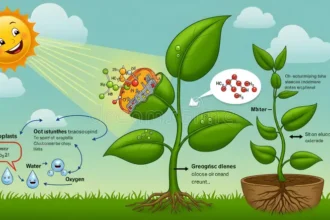

Plants rely on three primary sources for their essential nutrients and energy: air, water, and soil. These elements work in conjunction to support plant growth and development.
1. Air: Carbon and Oxygen
The air provides two vital components to plants: carbon and oxygen.
- Carbon is obtained by plants in the form of carbon dioxide (CO₂), which is essential for photosynthesis. During photosynthesis, plants reduce carbon dioxide to form sugars, which are used as energy for growth and development. The leaves of plants absorb carbon dioxide from the air through small openings called stomata.
- Oxygen is also vital for plant processes, particularly respiration, which occurs both in the plant’s aerial parts and roots. The oxygen present in the air, as well as in the soil, is absorbed by the plant to fuel its metabolism, providing the energy needed for growth.
2. Water: Dissociation and Oxygen Release
Water is another crucial source of nutrients for plants. Water is absorbed through the roots and plays several roles in plant life:
- During the process of photosynthesis, water is dissociated into hydrogen and oxygen. The hydrogen is used to form sugars, while the oxygen is released back into the atmosphere. Thus, water is vital not only for nutrient transport but also for the plant’s energy production.
- Water also acts as a solvent in the soil, carrying dissolved minerals that plants absorb. This water is essential for transporting nutrients to various parts of the plant.
3. Soil: Nutrient Reservoir
The soil provides the bulk of the nutrients that plants need for growth. These nutrients come primarily in the form of mineral ions, which plants absorb through their roots.
- Mineral Nutrients: The soil supplies the plant with several essential nutrients, including nitrogen (N), phosphorus (P), potassium (K), calcium (Ca), magnesium (Mg), sulfur (S), and trace elements or micronutrients. These elements are dissolved in the soil’s water, and the plant roots absorb them selectively.
- Nitrogen Fixation: Nitrogen, one of the most critical nutrients, is absorbed by plants as ammonium (NH₄⁺) and nitrate (NO₃⁻) ions. However, certain plants, especially those in the Fabaceae (legume) family, have the unique ability to fix atmospheric nitrogen (N₂) through a symbiotic relationship with rhizobium bacteria in their root nodules. These bacteria convert nitrogen from the air into a form that the plant can use to synthesize proteins.
4. Chlorophyll Assimilation and Photosynthesis
A. Photosynthesis
Photosynthesis is the process by which plants use sunlight to produce glucose, the primary energy source for growth. During this process:
- Carbon dioxide (CO₂) from the air and water (H₂O) absorbed by the roots are used to produce glucose (C₆H₁₂O₆) and oxygen (O₂).
- This process takes place in the chloroplasts of the leaves, where chlorophyll captures the energy from sunlight. Chlorophyll absorbs light primarily in the blue and red wavelengths, converting this energy into chemical energy stored in glucose molecules.
B. Chlorophyll Assimilation
Chlorophyll assimilation refers to the process by which plants capture light energy to produce carbohydrates from carbon dioxide and water, with the aid of essential mineral salts. This process is vital for plant metabolism and growth.
Conclusion
The air, water, and soil each provide indispensable elements for plant growth. The air supplies carbon for photosynthesis and oxygen for respiration. Water is essential for metabolic processes, transporting nutrients, and participating in photosynthesis. The soil offers a wealth of nutrients in the form of minerals and elements that are absorbed by the plant roots, ensuring healthy growth. Through the process of nitrogen fixation and the absorption of essential nutrients, plants are able to sustain their development, utilizing the elements from the environment to fuel growth and reproduction.